Two Mornings, Seven Trout
A calm, crowded morning and a wet, empty one on the same lowland lake, with a rig change in between.
What the engine said
Two sheets, one for each morning, and a rating on neither. The engine scored the bank both mornings, a middle word each time: Prepare, worth planning, at 68 on Thursday and 61 on Friday. But each of those numbers came with a range that ran all the way from Wait to Go, because the engine still can’t read how this lake produces or what its trout are doing at this time of year. A word that could be any of three tells you nothing, so neither sheet printed one. Each gave what it could read and said plainly what it couldn’t.
Thursday’s sheet went out at about five that morning, for the bank from first light to nine. Friday’s was built on Wednesday and run again on Thursday evening on a fresh forecast, for the bank at first light and then a small kayak if the wind allowed. On that forecast it didn’t: the sheet called Friday not a kayak day.
What it was reading
Thursday, from the bank, first light to nine. Mostly sunny with a high near 75 F, but 47 to 48 F on the bank through the session, and almost no wind. Five trout a day under the statewide lake rule, any size, and with bait on the hook every trout you could legally keep counts toward the five. The water temperature was a long-term typical value for the date, about 59 F, from a modelled daily record that ends in 2020, with a stated error of about 4 F. A recent catchable plant of rainbow, the only one in eight weeks. The public ramp, the only shore access. The methods were the sourced ones for fall: a worm or egg suspended under a float, a fly on still water, a small jig.
Friday, the same lake, from the bank and then perhaps the kayak. Rain likely before 9 am, a 70% chance, and a high near 62 F. Wind about 15 mph with gusts to 22 on the bank, and 16 gusting 23 for the kayak hours. The angler’s own limit for his sit-in kayak is gusts of 8 to 10 mph or a steady wind of about 4 to 6, so the sheet said to stay on the bank. Everything else was Thursday’s: the rules, the plant, the long-term water temperature, the methods.
What it couldn’t see, both mornings: how well the lake produces, what the trout were doing at that water temperature, how crowded the bank would be, and this year’s water temperature.
Scoring the call
No rating printed, so by the trip-report rule there is no tier to grade. What can be held up against the mornings is the word the engine reached and didn’t print, and each thing the sheets did say.
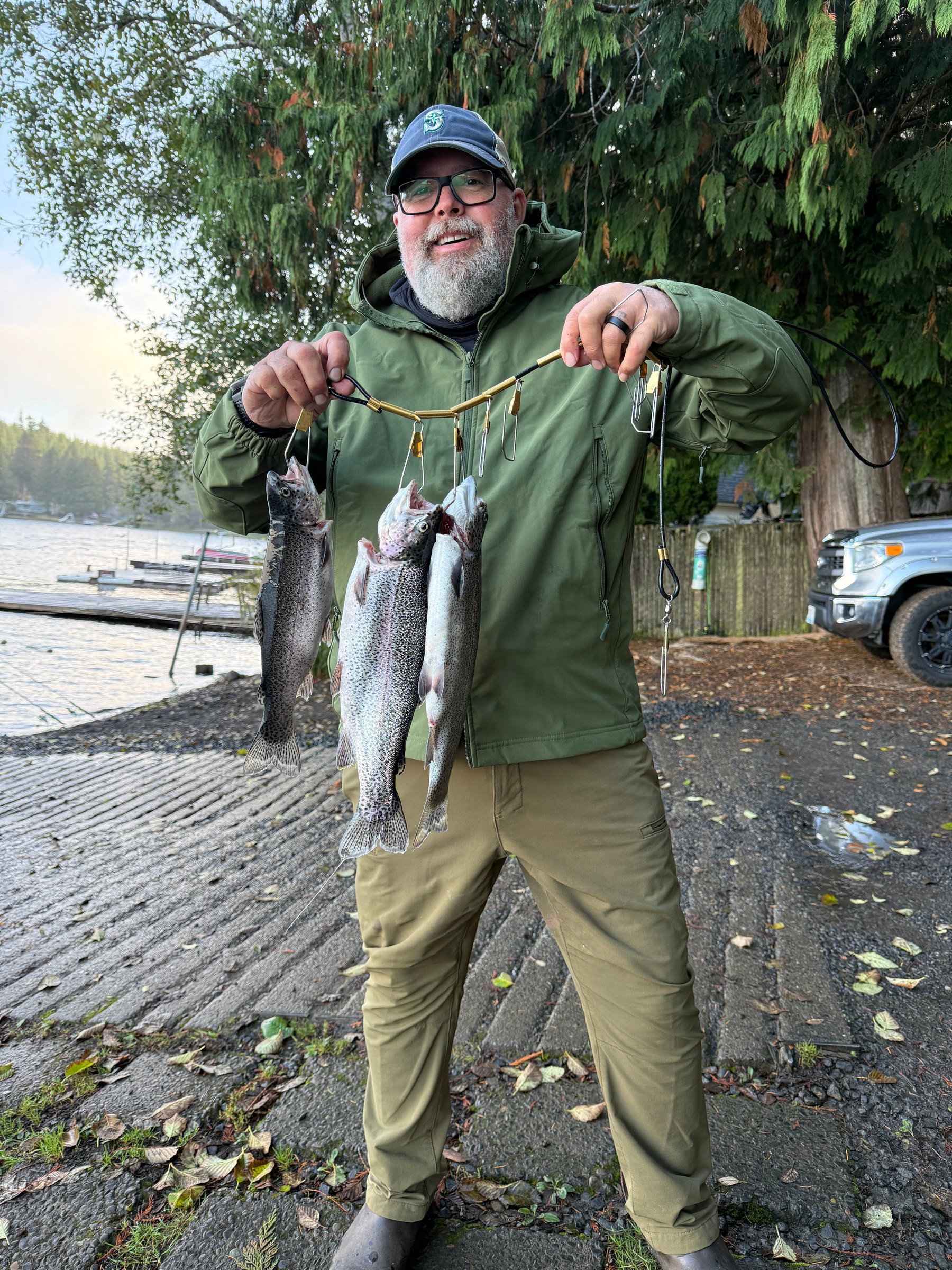
- Friday: one word low. The engine’s word was worth planning. By count it was a typical morning, three trout in two hours and forty minutes. What made it better than typical was the size, rainbows of 20 and 18 inches, measured, and the room: three anglers on the bank and no boats to reel in for.
- Thursday: worth planning held. A typical catch, four trout of 15 to 17 inches in three hours and twenty minutes, on a bank that filled to eight anglers with four boats out, every launch moving the bank.
- The kayak call: not tested. The kayak stayed on the truck. On the water there were a few gusts and no whitecaps, on a lake he has seen whitecap, which suggests the wind ran under the forecast. Nobody measured whether it stayed inside the sit-in’s limits, so one morning can’t say whether the call was too cautious.
- The water temperature against the thermometer. The engine had about 59 F, give or take about 4 F. The lake read 63.5 F at seven on Thursday, after warm days, outside that error. It read 61.5 F at half past eight on Friday, after a night of rain, back inside it.
- The methods. Both sheets listed the sourced fall methods: bait under a float, a fly on still water, a small jig. Both mornings, every trout came on a Carolina rig, bait on the bottom, which wasn’t on the list. The listed methods weren’t tried, so they can’t be graded, but the one that worked wasn’t offered.
- The bigger fish. Every trout this month had been 17 inches or smaller. WDFW’s stocking records, current to 7 October, show nothing new here since the plant both sheets carried. Whether Friday’s two big rainbows came from a plant not yet posted, or were fish that held over, can’t be determined yet.
What the two mornings showed
- The catch rate mostly held. About one trout an hour on Thursday, on Friday and on the first Saturday of the month, through a crowded bank and an empty one, clear skies and rain, and a rig change. The exception was the Sunday between, with the bank to one angler, when the limit came before eight. Counts this small only rule out large effects, and that Sunday shows the rate can move a long way.
- The crowd followed the weather. Consecutive weekdays, the same lake, the same plant: eight on the bank and four boats on the calm, clear morning; three and none on the wet one.
- When it stopped, and why, is still open. On the clear, calm morning the bank went quiet after 8:20 while the boats kept catching beyond the end of the casts. On the overcast morning, with no boats out, the bank caught until 8:50. Friday had cloud and no boats, so it removed both suspects at once, and one pair of mornings can’t separate them.
A Lowland Lake in Western Washington, October 8–9, 2026
Thursday morning started at six, under clear skies with the lake nearly motionless. Water temperature was 63.5 degrees, and I had both rods fishing by 6:10, using the same Carolina rigs I’ve been working with on previous trips.
The first trout came at 6:40, about the same time the first boat launched. Another boat followed ten minutes later, and the bank began filling up. I landed my second trout at 7:20, and by 7:36 there were seven of us fishing from shore. A third came at 7:39 and a fourth at 8:20. Two other fish were caught along the bank, but after 8:20 it went quiet. Eight fishermen were sharing the shoreline by 8:31, and four boats had launched by the time I left. The interesting part was watching the boats continue catching fish while trolling beyond our reach. The trout hadn’t necessarily stopped feeding. They simply weren’t where we could get to them.
I was off the water at 9:30, already considering what I might change the following morning.
Friday brought a different lake. I arrived at six to light rain and a moderate wind moving across the open water. No other fishermen, no boats, and plenty of room. By 6:20, both rods were fishing, but with two adjustments. I’d increased the weight to 3/4 ounce, gaining roughly twenty yards of casting distance, and moved up to a #1 offset circle hook, allowing me to use a whole nightcrawler instead of half.
The rain stopped at 7:14. Six minutes later, the first fish came in at fifteen inches. At 7:24, a twenty-incher. At 7:31, an eighteen-incher. Three quality trout in eleven minutes, including a cutthroat. After an hour of nothing, the morning had suddenly come alive.
Two other bank fishermen arrived around 7:35. The clouds began breaking apart, and the wind picked up, occasionally gusting but never producing whitecaps. Water temperature measured 61.5 degrees at 8:30, two degrees cooler than the previous morning. The other fishermen caught fish at 8:10 and 8:50, but my rods remained quiet. I left at nine, and not a single boat had launched.
Two consecutive mornings, seven trout, and two very different sets of conditions. Thursday was calm, clear, warmer, and increasingly crowded. Friday was cooler, wet, windy, and nearly deserted.
The most useful observation came from Thursday. I could see the boats catching fish beyond where I could cast. Friday’s additional weight gave me another twenty yards of reach, and the larger hook allowed a more substantial bait presentation. Whether those adjustments accounted for Friday’s better fish is impossible to say with certainty, but they addressed something I’d actually observed rather than something I’d merely assumed.
That’s the part of fishing I enjoy nearly as much as catching. Every morning offers a little more information, provided you’re paying attention. Sometimes it confirms what you thought you knew. Other times it gives you a reason to change.
And occasionally, it hands you three good trout in eleven minutes.
A planning aid, not a prediction of catch and not a safety determination: the score ranks how far the conditions it was given favour the fishing asked about, and the conditions are supplied by a person, not read from a feed. Verify regulations with WDFW. Going out, and getting home, is yours alone.