The Confidence to Make One More Cast
Confidence is knowledge converted into action. And fishing requires an enormous amount of it.
There are lures in my tackle box I don’t trust.
There is nothing wrong with them. Someone catches fish on them, probably lots of people. They were designed correctly. They have good hooks. The color makes sense. They run at the advertised depth. I’ve probably even bought more than one of them, which is its own kind of fishing logic.
But I don’t trust them. So I don’t fish them very often, and when I do, I fish them differently.
That’s the part I’ve been thinking about. Because the lure doesn’t know whether I believe in it. The fish certainly doesn’t know. Yet somehow confidence still affects what happens at the other end of the line.
Knowledge’s Outward Appearance
I’ve started thinking of confidence as knowledge’s outward appearance.
Not knowledge itself. That’s an important distinction.
Knowledge is what I’ve accumulated: experience, time on the water, mistakes, successful trips and failed ones, reading, talking with other fishermen, understanding seasonal movement, learning a piece of water, knowing what a lure does at a particular speed or what a fish is likely doing at a particular temperature.
Confidence is what all of that looks like when it’s time to make a decision. It’s tying on a lure without immediately wondering whether I should have chosen another one. It’s making a cast toward a piece of structure because I understand why a fish might be there. It’s staying with a presentation long enough to actually test it.
Confidence is knowledge converted into action. And fishing requires an enormous amount of it.
We should get something out of the way, though. Fish don’t care how confident I am. A walleye isn’t sitting twenty feet down evaluating my self-esteem. A salmon isn’t more likely to strike because I’ve developed a positive attitude. Bass aren’t impressed by motivational thinking.
There are physical things happening underwater: temperature, light, current, depth, forage, structure, predator behavior, presentation. Those things affect fish. My feelings do not.
So when fishermen say things like, “You have to believe in the lure,” I’ve always been a little suspicious. The fish doesn’t know what I believe.
But I do. And that’s where things get complicated.
One More Cast
Give me a lure I trust and watch what happens. I fish it longer. I pay closer attention. I make better casts. I think about where it’s running and adjust speed deliberately. I notice what the bottom feels like and recognize a change in vibration. I put it back into places where I think a fish should be instead of randomly covering water. Most importantly, I give it time.
Now give me something I don’t trust. Three casts. Nothing. Maybe five. Then I’m looking at the tackle box.
The lure never really got tested. What failed? The lure, the location, the presentation, or my confidence? That’s almost impossible to separate afterward. Which means confidence has somehow influenced the outcome without ever affecting the fish directly.
Fishing is full of decisions made with incomplete information. Move or stay. Shallow or deep. Fast or slow. Natural color or something obnoxiously chartreuse. Change locations, change species, change lure, or change nothing. There usually isn’t enough information to know which decision is correct.
So eventually knowledge reaches its limit, and something else has to carry the decision forward. Confidence does that. Not blind confidence. Earned confidence.
I’ve caught fish here before. I’ve seen these conditions before. The water temperature makes sense. The structure is right. The fish should be transitioning through this depth. My presentation is doing what I want it to do. Nothing has happened yet.
Those facts can coexist. Confidence is what allows me to make one more cast without needing immediate proof that the decision was correct.
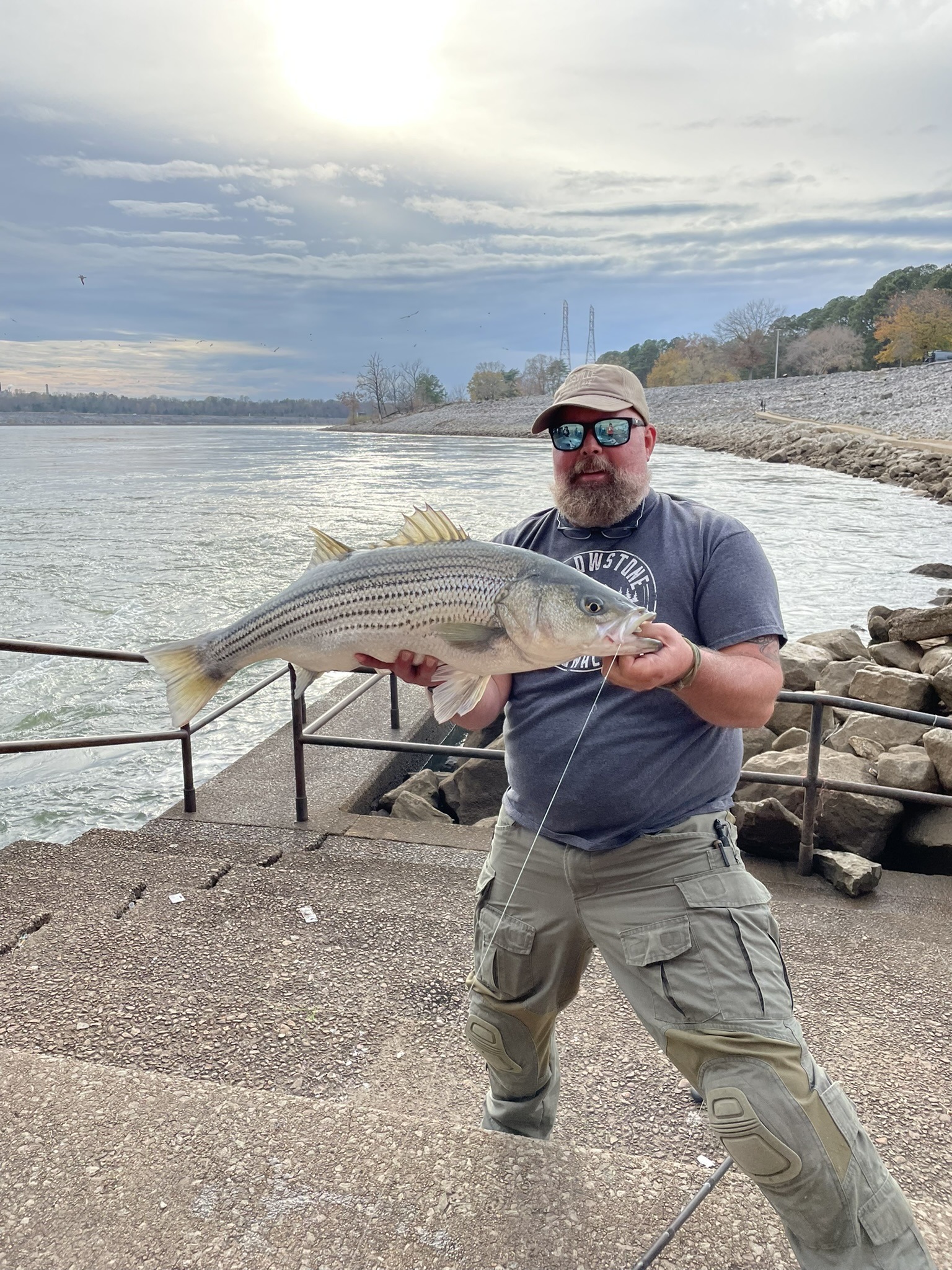
I was standing below a dam, fishing tailwater I didn’t know, for a fish I didn’t know particularly well, with a lure I wasn’t convinced would work. Current pushed one direction, folded back on itself somewhere else, boiled to the surface and disappeared again. Somewhere underneath all of that were striped bass. At least that’s what I had read.
At the end of my line was a 1.5-ounce jighead with a four-inch white fluke. I wish there were a better story behind that selection. There isn’t. I found it on the internet.
Ten casts. Maybe fifteen. Nothing. Every cast seemed to create another question. Was I deep enough? Too fast? Was white even the right color? By twenty, I was thinking about changing something. The problem was I didn’t know what to change, and without knowing why you’re changing it, you’re mostly just replacing one uncertainty with another.
So I didn’t. I made another cast.
And then I got run over by a freight train. No tap. No slight change in pressure. The rod loaded and something on the other end simply decided it was leaving.
I made the next cast differently. Physically, I probably did almost exactly the same thing. But now I expected something to happen. I could feel the jig instead of wondering whether I was feeling it correctly. That current seam I’d been suspicious of suddenly looked like somewhere a fish should live.
Same water. Same jig. Same fisherman. One cast apart.
Confidence changes attention, too. When I understand what I’m trying to do, I notice more. A slight change in depth means something. A different bottom composition matters. Bird activity becomes interesting. Current seams become visible. A change on the electronics isn’t just something on the screen. I’m looking for relationships because I have enough knowledge to believe relationships are there. Without that foundation, it’s just water.
This is probably why experienced fishermen sometimes seem to have an instinct for things they can’t immediately explain. Maybe some of it is instinct. But I suspect much of it is compressed experience. They’ve seen enough small things together often enough that their brain recognizes the pattern before they consciously explain it. We call that confidence. But somewhere underneath it are thousands of casts.
Fishing with other people makes this particularly obvious. Someone says, “They’re on that point.” Maybe I was already looking at the same point. Nothing about the point changed when he said it. But if I trust that fisherman, something in me changes. Now I’m looking harder. Why does he think they’re there? Depth, wind, current, structure, experience? Maybe he knows something I don’t. His confidence has altered my attention.
Confidence can move between fishermen. So can doubt. One person changes lures and suddenly everyone wonders whether they should. One person says the bite is over and five minutes later the boat is moving. None of this changes what the fish are doing. It changes what we are doing. And sometimes that’s enough.
Confidence Has a Shadow
Catch a fish on that next cast and suddenly the entire decision looks brilliant. I knew it.
Except I didn’t. I believed I had enough information to continue. That’s different.
Fishing has a nasty habit of rewarding bad decisions and punishing good ones. You can fish the wrong lure in the wrong place and catch the most aggressive fish in the lake. You can make a nearly perfect decision and get skunked. If we’re not careful, we build confidence from outcomes rather than knowledge. Caught fish, therefore correct. Didn’t catch fish, therefore wrong.
I don’t think fishing works that cleanly.
Sometimes a fish is evidence.
Sometimes it’s just a fish.
Knowing the difference may be one of the hardest things in fishing.
The same confidence that keeps me fishing effectively can also keep me fishing something long after I should have abandoned it. I’ve caught them here before. I’ve caught them on this lure before. This always works. Now knowledge’s outward appearance has become something else: stubbornness, maybe even arrogance.
That’s the boundary I’m interested in. Too little confidence and I’m constantly changing things before I’ve learned anything. Too much confidence and I stop noticing evidence that contradicts what I already believe. Somewhere between those is a useful fisherman: confident enough to commit, uncertain enough to keep watching.
That balance is harder than it sounds.
Data Doesn’t Eliminate This
I’ve spent a lot of time building tools designed to make fishing decisions more objective: temperature, weather, flow, run timing, catch history, pressure, availability. The idea is to replace some guessing with evidence. I believe deeply in that.
But the more I work with the data, the more I realize it doesn’t eliminate confidence. It changes where confidence comes from. Instead of I just have a feeling, maybe I can say I’ve seen enough evidence to believe this is worth trying. That’s better.
But eventually the data ends. The forecast gives me probabilities. The engine gives me a score. The map gives me a location. None of them make the cast.
At some point I still have to decide: here, now, this lure, this depth, one more cast. That’s where confidence lives, just beyond the edge of what I can prove.
Maybe becoming a better fisherman isn’t about becoming more confident. Maybe it’s about becoming more careful about what deserves confidence. Experience should earn some. Evidence should earn some. Understanding why something works should earn more than simply remembering that it worked once. And being wrong should take some away. Not from my willingness to fish. From my certainty about what I think I know.
I don’t want an engine that makes me certain. I don’t want experience to make me certain either. Certainty closes the question, and fishing rarely rewards that for long.
What I want is enough knowledge to make a deliberate decision and enough humility to change it when the water tells me I’m wrong. Not believing that I know what’s going to happen. Believing that I know enough to begin.
The fish doesn’t care whether I’m confident. The water doesn’t care what I know. But confidence changes the fisherman standing in front of that water: what I notice, what I try, how long I try it, what I learn when it fails, and whether I make one more cast.
Maybe that’s why confidence matters.
Not because it changes the odds.
Because it changes what I do with them.